
Dice Probability Guide
Understand dice notation, sample spaces and the difference between chance, average and a sample roll.
Read the notation
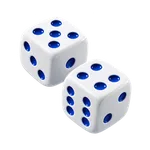
2d6 means two six-sided dice. Unless stated otherwise, add their values. A +3 modifier adds three to the total. Mixed notation such as 1d8 + 1d4 describes different independent dice.
Count ordered outcomes
Two D6s have 6 × 6 = 36 ordered outcomes. The pairs (2,5) and (5,2) are separate outcomes, even though both sum to 7.
Choose the right question
Exactly 7 means total 7 only. At least 7 includes 7 and higher. At most 7 includes 7 and lower. A dice pool counts successful dice rather than adding their face values.
Mean, variance and standard deviation
Mean is the expected value over repeated trials. Variance measures squared spread around that mean, and standard deviation is its square root. None of them guarantees the next roll.
Use a suitable tool
Start with the dice probability calculator for sums, the average calculator for expressions, the dice pool calculator for success counts and weighted dice for custom face weights. Use advanced dice rules only when their definitions match your game, and the dice roller when you want a random sample instead of a probability.
Sample spaces, permutations and combinations
For n independent s-sided dice there are sn equally likely ordered outcomes. Two D6s have 36 outcomes, while the 21 unordered pairs are not equally likely: a non-double pair has two orders and a double has one. Counting combinations as if each were equally likely gives incorrect dice odds.
To count a specified multiset, use n! divided by the product of each repeated face’s factorial. For the faces 1, 1, 2 there are 3!/2! = 3 orders out of 63 = 216 possible D6 rolls, so the probability is 1/72. Use the dice sum probability calculator when the event concerns an added total.
Conditional probability and coin-and-dice problems
Use conditional dice probability when one fact is already known: the sample space must be restricted to that condition. For independent heads and a six, multiply 1/2 by 1/6 to get 1/12; for heads or a six, add 1/2 + 1/6 and subtract their overlap 1/12 to get 7/12.
The coin and dice probability guide explains these event rules. The dice roll frequency guide separates observed frequency from theoretical probability. For your own spreadsheet, see dice probability in Excel.
Calculate dice combinations
The dice combinations and permutations calculator counts arrangements of wanted faces and gives their exact probability. Repeated faces reduce the number of distinct permutations.
Practice questions with worked answers
There are 36 equally likely ordered face pairs. Six total 7. The eleven possible totals are not equally likely, so 6/36 = 1/6.
The outcome counts are 25, 27, 27 and 25. Add them to get 104 out of 216: 13/27, about 48.15%. Both endpoints are included.
Add the independent die means and subtract the constant: 4.5 + 2.5 − 1 = 6. The range is 1 through 11.
No six has probability (5/6)⁴. Subtract from 1 to get 671/1296, about 51.77%. Four times 1/6 would double-count rolls with multiple sixes.
No. Six is the expected count in ten independent trials with the same 60% chance. Actual batches vary; previous failures do not make the next success due.